Develop federal leaders at every level, from first job to the executive bench
The Center for Leadership and Management runs four cohort-based programs covering GS 1 through GS 15. Built on OPM's competency framework, taught by federal practitioners, and running since 1995.

Trusted across the federal government















Agency seals reflect organizations Graduate School USA has trained. They do not imply endorsement by, or affiliation with, any federal agency.
One continuum, four programs, GS 1 through GS 15
Most leadership training is a course. CLM runs a continuum: each program picks up where the last one ends, so an agency can develop a person from their first professional role through executive readiness without changing providers or frameworks.
Aspiring Leader Program
Six weeks for employees up to GS 7. Foundations, professional presence, and a career plan presented to the cohort. Built on OPM's six Fundamental Competencies.
Explore the programNew Leader Program
Six months for GS 7 to GS 11. A 360-degree assessment, a supervisor-approved development plan, a four-week developmental assignment, and a team project.
Explore the programExecutive Leadership Program
Nine months for GS 11 to GS 13. A mentor, a six-week developmental assignment, executive shadowing and interviews, and a team project.
Explore the programExecutive Potential Program
Twelve months for GS 13 to GS 15. An SES-level mentor, an action learning project, a developmental assignment, and a portfolio tied to the Executive Core Qualifications.
Explore the programThe federal leadership gap is a documented risk
This is not a soft investment. Leadership capacity is a standing legal obligation, a measured driver of engagement and retention, and a named federal risk area.
It is required by regulation
5 CFR 412.202 requires agencies to train supervisors within one year of their first supervisory appointment, and to follow up at least once every three years, including when someone moves from non-supervisor to manager or manager to executive.
Most new supervisors never got it
MSPB found only 64 percent of federal first-level supervisors received training in or before their first year, and of those, almost half received one week or less.
Skills gaps are a GAO high-risk area
Strategic human capital management has been on GAO's High-Risk List since 2001. In the 2025 list, 20 of the 38 high-risk areas are there in part because of skills gaps or inadequate staffing.
Leaders drive engagement and retention
Gallup finds managers account for at least 70 percent of the variance in team engagement. In a study of 354,374 federal survey responses, each one-point gain in the FEVS Leaders Lead score was associated with 45 percent lower odds of intending to leave within a year.
Leadership training measurably works
A meta-analysis of 335 independent samples in the Journal of Applied Psychology found large effects on transfer of behavior to the job and on organizational results, not just on how participants rated the training.
Institutional knowledge is walking out
GAO reported that of employees who separated from OPM between December 2024 and March 2026, 57 percent had 11 or more years of service, a significant loss of institutional knowledge. Succession benches are thinner than they were.
Why cohort programs outperform a class
Every CLM long-term program is built on the same three components. The combination is what moves behavior, and it is why these programs run in months rather than days.
Assessment
The Leadership Effectiveness Inventory, CLM's 360-degree instrument developed with OPM and built on its leadership competency framework, gathers structured feedback from supervisors, peers, and direct reports. It is the diagnostic that everything else is aimed at.
- 360-degree input, not self-report alone
- Results drive a written development plan
- The plan is approved by the participant's own supervisor
Experiential learning
Participants leave their desk. Developmental assignments, executive shadowing, structured interviews with senior leaders, and team projects on real federal problems put the training under load while it is still fresh.
- Developmental assignments from four to sixteen weeks
- Shadowing leaders two or more grades above
- Team projects delivered to the cohort
Individual development
A mentor, one-on-one sessions, book and content reviews, and a capstone impact paper that forces the participant to articulate what changed, what it was worth to the agency, and what comes next.
- Mentor retained for the full program
- One-on-one mentoring outside of class
- A capstone Program Impact Paper
What graduates say
Verbatim from Graduate School USA program pages, across all four programs.
An all-access pass to the exclusive world of senior federal leadership. It provided me with the background information I needed to develop into a senior executive.
Exposed me to individuals at the Senior Executive level who provided insight to career opportunities. I have been able to not only discuss what good leadership looks like, but see it in action.
When I started this program I thought I was too junior and that my participation was pre-mature. One year later, I find myself staring down a winding road with paths I've never noticed.
The ELP exceeded my expectations. Each session and deliverable provided me with critical lessons, and I now have a better sense of who I want to be as a leader.
This program helped bring out qualities that had gone dormant, which have now been reactivated so that I can be the absolute best person, best man, and best leader that I can be.
My agency benefits from this program by having an employee with sharpened leadership skills, honed by constructive feedback, motivated to give back, particularly to future generations.
ELP was one of the best training and development experiences I've had in my government career. My mentor told me to use it like a golden ticket and seek out experiences that I'm interested in. I interviewed high-level executives, shadowed interesting people, and went on an eight-week long developmental assignment to put my leadership skills to practice.
The New Leader Program is not only an investment in you as an employee, but it is an investment in you as a person, for you grow in unimaginable ways. I am proof that the program works, for it not only changed the course of my career by opening doors that I could not have opened otherwise, but it also changed the course of my life.
The NLP strengthened my ability to analyze organizational challenges, communicate with clarity amongst my peers, and gave me the tools to gain the courage to lead with purpose. The experience affirmed my long-term commitment to grow into roles that influence people, culture, and mission outcomes.
When I joined this class, I was worried about the amount of work, as my job is a lot of work in itself. I also am not a fan of group projects, but my group is what got me through this program. Without them, I would not have grown as much as I did.
It was through the program that I recognized the next steps in my leadership journey. An opportunity came up that I applied for, and it was announced today that I got the job. I just want to thank you and the program for helping to guide me down the leadership path.
The Career Portfolio Presentation incredibly helped me articulate my professional journey and aspirations. I learned how to craft a narrative that highlights my skills, experiences, and values. Practicing in a supportive environment allowed me to build confidence in my presentation abilities.
Built on the framework your agency is already measured by
OPM's Executive Core Qualifications govern entry to the Senior Executive Service and are used across government in selection, performance management, and leadership development. OPM updated the ECQs effective October 1, 2025. The five current qualifications are below. CLM curricula are built on OPM's ECQ framework, and the Executive Potential Program is focused on the current framework.
Commitment to the Rule of Law and the Principles of the American Founding
Knowledge of the American system of government, commitment to the rule of law, and civic-mindedness.
Driving Efficiency
Fiscal responsibility, managing resources, and leveraging technology.
Merit and Competence
Technical skill, problem solving, and agility and resilience.
Leading People
Accountability, developing others, and executive judgement. This is the theme of the Executive Leadership Program.
Achieving Results
Operational mindset, innovation, and strategic thinking.
Why it matters below the SES
The ECQs are not only an SES application requirement. OPM states they are used in selection, performance management, and leadership development for management and executive positions, which is why developing against them early compounds.
Vetted procurement, right from the GSA Schedule
Graduate School USA is a GSA Multiple Award Schedule contract holder, allowing federal agencies and other qualifying organizations to confidently purchase our services.
- GSA MAS contract 47QRAA24D004K, SINs 611430 (professional training) and 541611 (management/administrative consulting)
- Held as American Public Training LLC d/b/a Graduate School USA; UEI LA83MCFN1ST3; CAGE 99AA0
- We work with your training office on the paperwork, whether a Schedule order, purchase order, or an SF-182.
The Center for Leadership and Management
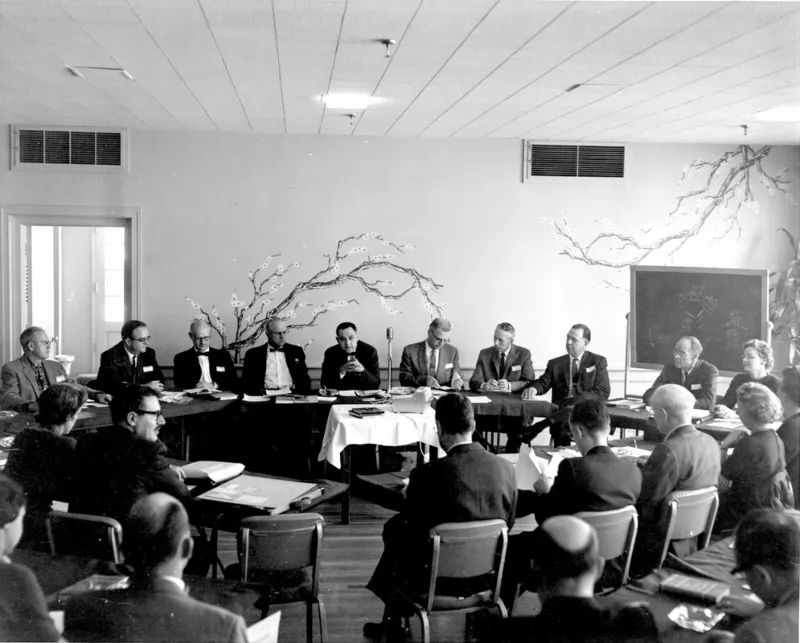
Graduate School USA was established by the Secretary of Agriculture on September 2, 1921. On May 16, 1995, the Office of Personnel Management transferred eight of its training centers to the school, and the Center for Leadership and Management was created out of that transfer. CLM has trained more than 10,000 emerging federal leaders since, and Graduate School USA is accredited by ACCET, a U.S. Department of Education recognized accreditor.
- Founded 1921 as the USDA Graduate School; 500,000+ government employees trained across 125+ agencies
- ACCET-accredited (ACCET is a U.S. Department of Education-recognized accreditor)
- Center for Leadership and Management runs ECQ-aligned executive development, including the Executive Potential Program since 1995
- 200+ federally experienced subject-matter experts across 400+ courses and certificates
- Available on an active GSA MAS Schedule (SINs 611430 and 541611)
Questions agencies ask
The answers training officers and program directors ask for most, in one place.
Which program is right for which employee?
Are these programs delivered in person or online?
Can we run a cohort just for our agency?
Does this satisfy our supervisory training obligation?
How does my agency buy training from Graduate School USA?
Can courses be tailored to our agency?
Can training be delivered virtually or in person?
Talk to the Center for Leadership and Management
Tell us the levels you need to develop, how many people, and your timeline. We will map them to the right program and cohort, and answer questions about funding and the SF-182.